Steve`s Country
For a smile as wide as a country sunrise
Thursday’s Thoughts #7.

Good morning everyone! It is another beautiful, sunny day here at Steve’s Country. It was totally calm earlier, but there is a light wind now and is supposed to be quite a strong wind by noon. I must admit I don’t really enjoy a strong wind, particularly when I go walking, because I can’t hear noises as well. I like to hear what is going on. It helps to find small birds that I might be able to photograph. It brings dragonflies and butterflies more out in the open. But when it is windy, I can’t hear these birds well and the insects tend to hide in more sheltered areas.
And it makes it harder to hear any dangerous animals that might be walking around. Speaking of bears. One was here during the day on Tuesday and had moved some rather large rocks that are around my landlords flower garden. Looking for ants or grubs no doubt. Everything was fine that morning, but I noticed the rocks had been moved when I got back from my walk. Then last night he was around again about 2am. But he didn’t find any food so he didn’t stay. But he remembers finding food here and he’s still checking it out, just in case.
That’s a real problem with bears, they don’t forget and they don’t give up easily. Now the question remains, can I make my feeders bear proof? I hope so. I just spotted a new chipmunk on the deck, very small, so obviously a baby from this year. He was wandering around the deck checking on empty peanut shells. He finally found a good peanut near the step. He picked it up and ran off excitedly. Now I need a new name for this little guy. I should wait and find out if it’s a male or female, or give it a generic name.
If you would like to join in, leave a name in the comments and I will put the names in a hat and draw out one for our new friend. Pocket and Skamper had quite a “discussion” this morning, they were rolling around in a tight ball and even bouncing around. That’s the worst fight I have seen among chipmunks, but they both want to be top chipmunk, and they are very evenly matched. It ended in a tie. I had some fun things happen to me yesterday while walking to the river, but I’ll leave those for tomorrow. I hope you have a great Thursday and God bless! (😺6 days)
Steve and Muffin.
©2021 Steve McLeod.
Steve And Muffin’s Wildflowers #28.
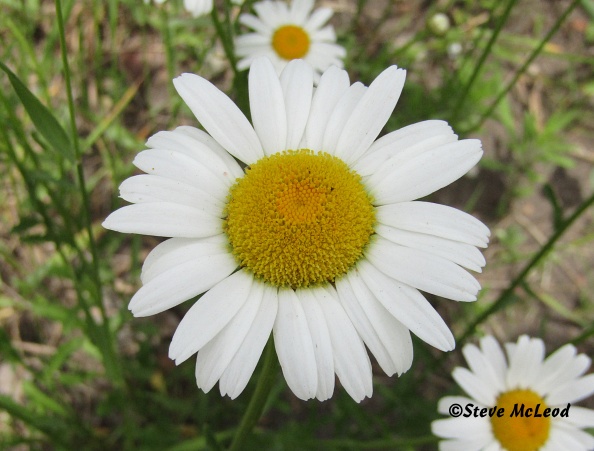
Hi everyone! Today’s wildflower is the “ox-eye daisy”, also called the “common daisy”. This is not a native wildflower but comes from Europe, it was brought here in the 1800s so it has now become a well established wildflower. Most people consider it a noxious weed and should be totally eradicated. But it really is a beautiful and cheery flower. Plus, it is a wildflower that attracts bees and butterflies better than most flowers. Considering the concern for our wild bees and butterflies, we should be encouraging these flowers, not getting rid of them. And they normally grow in areas where our native wildflowers don’t grow, such as along roadsides, in very poor soil, even in sand and gravel areas. But these are just my thoughts. They bloom from June to August, the flowers are about 2 inches (5cm) across and will grow up to 3 feet (90cm) high, though normally closer to 12 to 16 inches (30 to 40cm). They prefer sunny locations but will grow in partially shady areas too. They can be found throughout Canada and the US. I hope you have a great day and God bless!
Steve and Muffin.
©2021 Steve McLeod.

