Steve`s Country
For a smile as wide as a country sunrise
Coffee Time #100. Still Snowing.

Good morning everyone! Coffee is ready, nice and hot, just help yourself and relax while we have some fun this morning. Yes, it’s still snowing out there, this is day 3 now. Apparently this weather system has stalled over us, so we’re kind of locked in to this cold and snow. Good thing so much melted the last couple of days or there would be 8 inches (20cm) of snow on the ground. As it is there is 4 inches (10cm) of snow, and it’s snowing again. This isn’t good for the bird population, those that have returned from the south that is, they need food and they can’t get it.

I had dozens of juncos here on Sunday, there is only one out here the last couple of days and I didn’t see it this morning. Robins and flickers are silent. All these are ground feeders. However, on a fun note, I saw on Sunday afternoon one of the best chases between Skamper, my chipmunk, and 3 squirrels, Jasper, Freddie and Chase. Freddie was on the feeder, the other 2 were on the ground though I didn’t know that. Skamper comes for his peanuts. Freddie spots him, does the angry squirrel dance and the chase is on! Round the boxes they go and Skamper makes a sharp turn and into the peanut box and stands still. Freddie comes to a halt and looks around. Skamper starts chewing on a peanut. Freddie turns and the chase resumes. Skamper jumps off the deck, makes a perfect landing, Freddie tries, lands on his back but continues the chase.

Skamper runs past Jasper, who then jumps on Freddie as he tries to pass. What a scramble! Skamper continues to Chase who begins chasing Skamper. Now Skamper goes back to the other 2 squirrels and Chase joins the fight, but Freddie breaks free and goes after Skamper who hides behind a clump of grass. Freddie finally spots him and continues the chase around the grass and then back to Jasper and Chase who are still fighting. Skamper runs right between them and Freddie tries to do the same but Jasper jumps on him and Skamper comes back, Chase is a bit confused by now I think and he breaks free just as Skamper gets back and Skamper begins chasing Chase around in circles.

I don’t think Chase knew who was chasing him but he left and ran across the neighbors yard with Skamper still chasing him. Meanwhile Jasper chases Freddie back to the front yard. Skamper comes back and he and Jasper pass each other as they each go back to their feeding spots. Skamper is soon gathering peanuts while Jasper is eating sunflower seeds. You really had to see that one to get the full picture, but Skamper deliberately did his part and working with Jasper they got rid of the other 2 squirrels. That was just so amazing to see. Coincidence? Perhaps. But it looked deliberate to me. And Jasper didn’t even try to chase Skamper. Only Jasper has been around the last couple of days. It feels and looks like winter again. Have a wonderful day everyone and God bless!
Steve and Muffin.
©2021 Steve McLeod.
Steve’s Bird Of The Day #53.

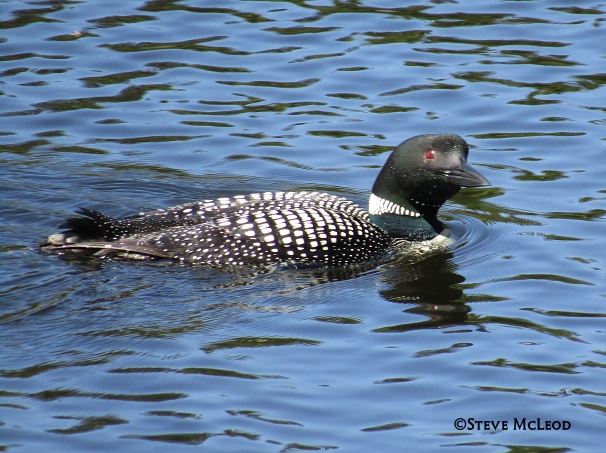
Hi everyone! Today’s bird is the “common loon”. There are 5 species of loons in N. America but this is the one that is most common and that most people are likely to see or hear. They breed from Alaska right through most of Canada in into the northernmost US states. They are even found on some of our Arctic islands. Both sexes look identical. They have four calls, one that sounds like it’s laughing, a long haunting cry, a yodel and a single noted hoo. Only the males do the yodel and each is totally unique so that each bird can be identified by it’s yodel. They can dive to depths of 250 feet (80 meters). They mostly eat fish of various kinds, plus crustaceans, salamanders and a few other things. They nest right beside water because their feet are place well back on their body making it difficult for them to walk much on land, but it aids them greatly in swimming and diving. Only 1 or 2 eggs is laid and usually only one chick survives to adulthood. Chicks ride on their parents back quite a bit for the first few days, to keep warm and safe from predators. Loons spend their winters on the east and west coasts of N. America. Adult loons are the first to leave in fall, followed by the young 2 to 3 weeks later. Common loon sightings and wonderful calls are a true wilderness joy.
Have a great day and God bless!
Steve and Muffin.
©2021 Steve McLeod.

