Steve`s Country
For a smile as wide as a country sunrise
Magnificent Mushrooms! #16
DISCLAIMER: This post is for information and interest only, it should not be considered a guide to edible wild mushrooms. Always go with a knowledgeable person when picking wild mushrooms.
Hi everyone! Time to look at yet another mushroom that is rather interesting, and quite common in our area. Well, it is listed in the books as a type of mushroom. Personally I think I would just call it a type of fungus. But, that’s what a mushroom is anyway so I guess it works either way.

White Coral Fungus beginning to grow.
So, here it is, the White Coral fungus (or mushroom). The first photo shows a young one just beginning to grow, the second photo is a more mature White Coral fungus, which changes color a bit as it matures, to a pinkish/tan color. It was a little hard to capture the color just right in that shade. There are several different varieties of corals and they can be difficult to tell apart at times.
Only a couple are considered edible, some are inedible (like this species) and some are toxic. Basically this means it is best to avoid eating them unless you are absolutely sure of which species you have found. They are quite common from June through to fall, especially after rain.
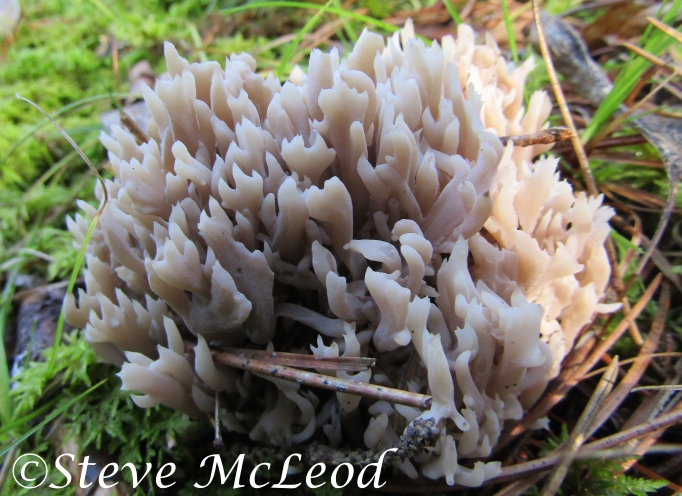
Mature White Coral fungus.
This species grows on the ground in areas of mixed hardwoods and conifers. I have found them growing in decaying pine needles and in moss (likely with decaying pine needles underneath). They can grow up to about 4 inches (10cm) tall and wide.
Personally I wouldn’t eat them, but they are a fascinating fungus to photograph. This species has no real odor or flavor to it. Well, I hope you have enjoyed this one, have a great day and God bless!
Steve and Muffin.
©2024 Steve McLeod.
 Steve`s Country