Steve`s Country
For a smile as wide as a country sunrise
Coffee At Steve’s Country #38. The Gray Jay #2.

Good morning everyone on this very cold Sunday morning! Help yourself to some steaming hot coffee and relax for a few minutes with us. Inside, where it’s somewhat warm. Have you ever felt that biting, bitter cold? Like this morning. I dressed more warmly than normal to go feed the birds because when I checked the temperature my eyes popped out. That’s why the question. It was a cold -47C (-53F) out there this morning. Even though I wasn’t out there long, I still got cold. My face was burning. Apparently frostbite could happen in 3 minutes or less. I believe it.
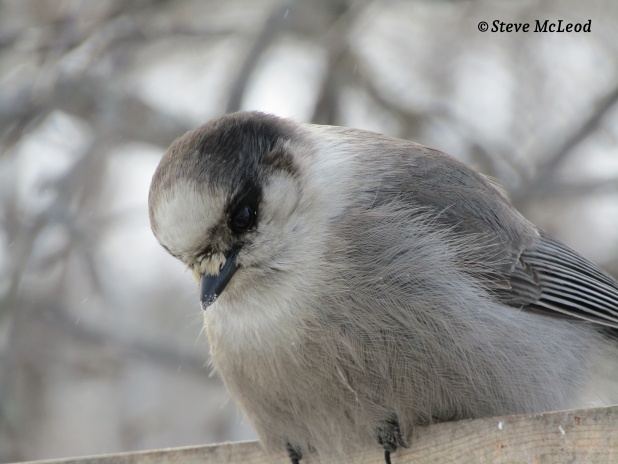
Well, back to our friendly gray jays. We saw yesterday that they nest very early, starting with nest building in February. They are able to nest so early in the season because of the large number of food caches that they hid among the trees the previous summer and fall. And actually because they nest so early they are able to start hiding food in the spring, so that they have abundant food to eat and to feed their young during a time of year when food is amazingly scarce. Unlike other jays, these gray jays don’t eat seeds or nuts so they rely heavily on their food reserves and anything else they might be able to pick up during the winter months.

When they come to the feeder they often go for the suet, or I will put out some meat for them, I usually have some wieners on hand just for them which they take happily. They lay 2 to 5 eggs, normally 3, in a well insulated nest on the south side of a tree and usually on the north side of some clearing, lake shore, river, stream, where the female and young will get the most sunshine. The male feeds the female and the young for the first week of their lives, by then they are fully covered with feathers and the female can begin to help out with feeding. The young usually leave the nest at about 23 days and can fly well but only for short distances.
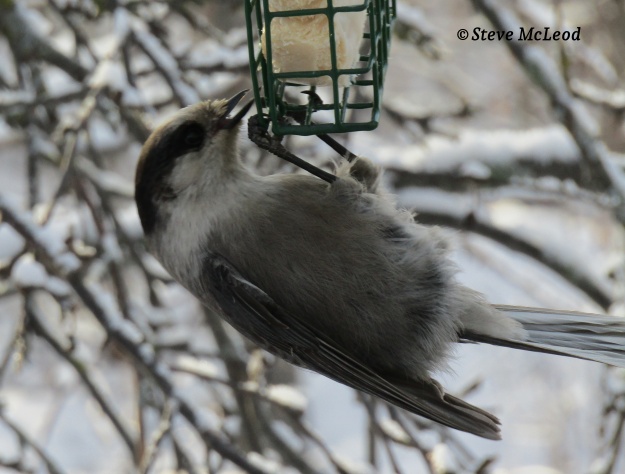
By 44 days they are flying very well and stay with the parents learning to find their own food. At about 60 days fighting begins between the siblings until the dominant one chases the others away, and that one will stay with the parents until the next spring. Gray jays mate for life, meaning they stay together until one dies, then they will take a new mate. Gray jays live longer than most birds their size and can live up to 15 years, but never leave their own territory. Young gray jays are dark gray all over and at one time were thought to be separate species. I’m sorry I don’t have a picture of the young in their gray outfits. By fall however they look like their parents. Well, this is just a brief look at these fascinating birds, I hope you enjoyed it. Have a wonderful Sunday and God bless!
Steve and Muffin.
©2021 Steve McLeod.
Coffee At Steve’s Country #37. The Gray Jay.

Good morning everyone on this very chilly Saturday. Time to grab a coffee, or tea, and relax with Muffin and I for a few minutes. It’s -21F (-29C), but with the windchill it’s actually -42F (-41C), and believe me, it is cold out there. I got cold just in the short time I was out putting fresh seeds out for the birds. That wind is bad, it always makes things worse. Those poor little birds out there this morning. And it’s going to get worse yet. But it is going to warm up this afternoon to -13F (-25C), if that can be considered warming up.
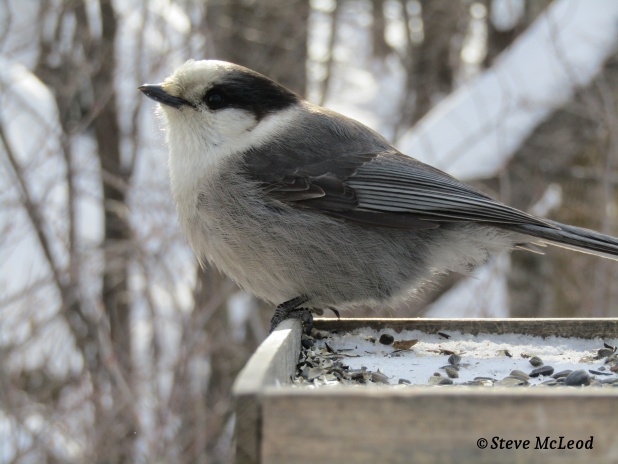
But it’s nice to be inside where it’s warm, watching the birds and listening to the booming and banging of the frost in the wood. It sure gets loud at times! Well, today we are going to look at one of my favorite birds, the gray jay. They are not colorful like other jays, they have a short bill whereas most jays have long bills and they are a weaker flyer than other jays. But they make up for these things with having a much nicer personality than other jays. They are very friendly birds, easily attracted to feeders and will, with just a little coaxing, land on a person’s hand to get food.
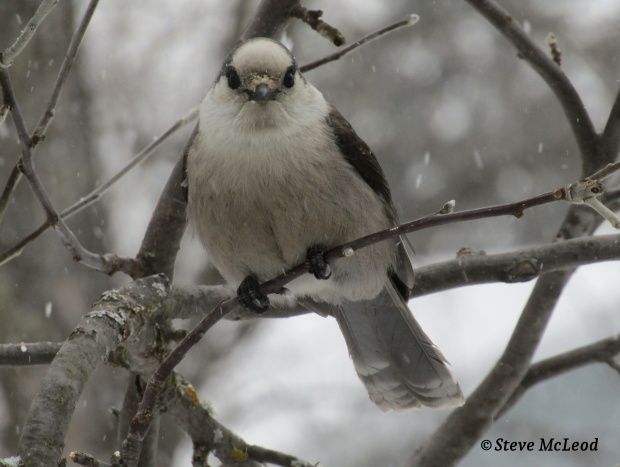
I have had them on my hand, arm, head and take food from my lips as well. They get very friendly with people in a short while and even their young will do the same. They can be found right across Canada, into Alaska and in the mountains as far south as California and Arizona. They are much quieter than other members of the crow and jay family, but still have many call notes and at least one song which is a series of soft musical notes sung by both sexes to each other. They are excellent at mimicking predators, such as hawks, to warn their mates and young of danger nearby. Their territory is generally around 65 to 70 hectares (160 to 172 acres), and they will stay on that territory their entire lives. Gray jays don’t migrate, even in their furthest northern part of their range. During the summer months when food is plentiful they will store food by first covering it thoroughly with their special saliva and then hiding it behind bark or under lichen or moss.
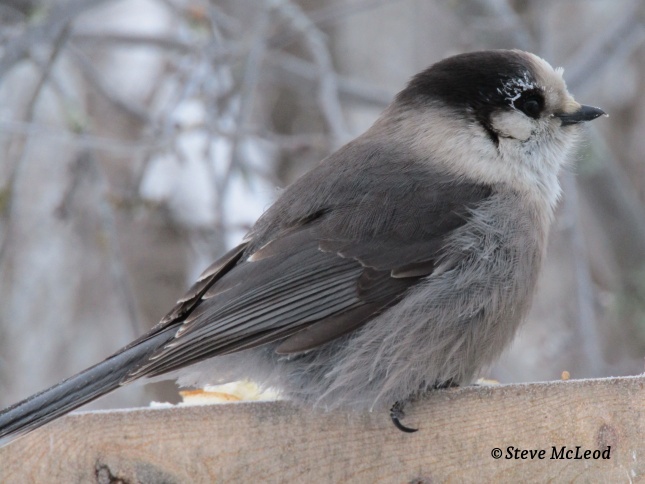
They never have large caches of food however, instead they spread it out evenly throughout their territory. By doing this they never lose large amounts of food to other birds or mammals that may find it. And they have remarkable memories, able to find this food again over the winter months. They begin nest building in early February and the female can be sitting on eggs by the end of February to the middle of March. During this time the male feeds her totally. It is not unusual for the female to be sitting on eggs with the temp at -30 or for the parents to be feeding young in a raging blizzard. It is not really fully understood why they breed so early in the year. But their hidden food stores do allow them the ability to do this successfully. Instead of making this post too long, I will do a second part tomorrow. These are just such interesting birds. Have a wonderful Saturday and God bless!
Steve and Muffin.
©2021 Steve McLeod.

